Every now and then I look at my life and wonder, "how did I get here?" Not that the level of drama, intrigue and adventure hasn't far exceeded my wildest dreams, but if someone had told my twenty-one-year-old self, "You will end up as a massage therapist in Brooklyn, living with cats," I would either have dismissed that person in total contempt or pegged them in the jaw, depending upon my state of mind at the time. Particularly in times of confusion and economic struggle, I wonder, "what was I thinking, during those carefree college days when I was Big Girl On Campus? How did I plan to make a living?"
After a few seconds of reflection, I remember the answer. I had what seemed like a solid, practical, realistic plan: get a BFA, get an MFA, get a gallery or two dealing my work, and teach. That was what our professors did; that was the assumed trajectory. This plan seemed realistic even in its humility; of course I wasn't counting on being an Art Star by the age of twenty-seven, just a professor by the age of thirty. With my acknowleged talent, discipline and 'cum laude' GPA, I didn't see how this could be a problem. Certainly I didn't count myself among the slackers who mumbled, "well, I like to draw, and I like drugs, so why not be an art major?"
Lordy, lordy, lordy.
Every so often I get an email from a stranger who has found my website and wants the inside scoop on SFAI. They never pay attention when I tell them "DO NOT DO IT. DO NOT GO TO THAT SCHOOL." When I tell them about the politics, the pettiness, the squabbles and backbiting and lack of practical assistance of any kind, they always think it sounds like an interesting challenge. They think, "I'm the talented one; I'm the one who will triumph. Lemme at 'em."
But lately I got hold of the one piece of information that convinces them of what I really mean. A very talented friend of mine from SFAI recently re-entered my life; she finally finished her undergraduate degree there, after a long set of detours. She is bright, holy, works like a maniac, and achieved more worldly recognition in her undergraduate days than a lot of SFAI professors ever will. She applied to some MFA programs and went to the SFAI faculty, of course, for the necessary recommendations.
One of those faculty members was the chair of the painting department, who for some reason, during my student days, always made me uncomfortable. I took a tutorial with her, and found that after one of her critiques I would destroy whatever piece I had been working on, and be unable to continue working for a week or two. Finally I started avoiding her, just so I could get something accomplished. She was nominally supportive of me only after I proved that I was not someone who fades into the woodwork when patronized, slapped down or ignored; we were on superficially good terms at graduation, but whenever I dropped by campus afterward, she didn't seem to recognize me.
Other former students, though, particularly the successful ones, spoke highly of her. "I know you don't like her, but she's been a second mother to me...". I wondered if I was just being an asshole.
Then my friend told me, "Chairwoman X has been on a lot of medication lately; that's probably why she said it. She came to me and confided, 'Darla, you don't realize it, but you're my competition now, and there aren't a lot of places for women in the art world. So I'm afraid I can't write you that recommendation.'"
Oh.
I ask you, what kind of an institution hires someone who thinks like that, let alone makes them head of a department? "The San Francisco Art Institute: We Specialize in Career Sabotage." A degree from SFAI guarantees nothing except that you will be qualified to operate an espresso machine for a living, provided you had the sense to do work-study in the student café.
What I see is that higher education, particularly in "soft" disciplines like art and literature, has become a sort of pyramid scheme, trading on the unconsidered, antiquated notion that a college degree always helps you get ahead. Colleges and universities have become economic entities that exist to sustain themselves, not the students they purport to be educating. A quick look at the numbers can show you that. An MFA from SFAI costs $40-60K; for every three tenured professors who retire, schools are hiring one part-time, non-tenure-track flunkey to replace them. The chances of making a decent living as a university art professor after graduating with an MFA are nearly nil--let alone paying off your monster debt.
This fact is borne out among my immediate acquaintance. I do not know a single person within twenty years of my age who holds an MFA and a teaching job which pays the bills. They're stocking groceries at the co-op, working in libraries, temping, doing short-term, exhausting and thankless teaching gigs in inner-city public schools, designing textiles, pumping espresso, or sponging off their spouses. Some of them were wise enough to learn a technical skill of some sort, and are eking out a living in web design or carpentry. Most of them have either settled down permanently at the bottom of the economic ladder, or have made a complete career change and are no longer making art at all.
The cold economics of the situation, moreover, are conflated with a not-so-subtle implication that poverty equals moral and artistic virtue. "How do we pay for this?" asked a freshman student, at SFAI's beginning-of-term assembly. "Learn to live on almost nothing," was the perfectly straight response, from the director himself. And it is true that practicing thrift and learning to prioritize has made my life infinitely richer and more enjoyable than if I were pulling down $100K a year in a profession that bored me.
But that was the sum total of practical economic advice or assistance we received from the institution as a whole. Trivial, sordid subjects like marketing, career management, portfolio presentation, accounting, taxes, contracts, negotiation, and intellectual property law were never mentioned; still less did we make any of those useful, much ballyhoo'd "career contacts" that are indispensible in the 24-7 schmooze-a-thon that is the 'art world.' On the contrary--should a professor or another student happen to have a close personal friend who was opening up a new gallery, or know a dealer who'd be interested in a certain person's style of work, that person kept mighty quiet about it.
All schools, of course, are different. Whenever I meet someone who is enrolled in an MFA program, or has graduated from one, I pick their brains. So far the only program I've heard about which provides genuinely stimulating assignments, adequate studio space, assigned faculty mentorship, career assistance and top-quality technical instruction is the California College of Arts and Crafts. All the rest of them seem to consist of marathon sessions of arcane rhetoric and emotional abuse, masquerading as "critiques," labyrinthine ego politics, and very little else.
This business of "critique" needs to be addressed as well. "Critique" is the institutional trump card, the biggest rhetorical power play they undertake to manipulate students into dropping $13K per semester. "You need to be able to talk about your work," they say. "You need to learn to think about your audience, to think critically, to learn the vocabulary." Tommyrot. The greatest artists I have known have, most of them, been completely inarticulate. They do what they do, regardless of the army of academics following them around and telling them that they're irrelevant.
Moreover, too much analysis, too early on, can kill a creative idea faster than a gallon of Raid. Truly powerful visual art is rarely a product of intellectual construct; it emerges from a different part of the brain. The verbal rationalizations and explications of a work of art generally take place long after the act of creation. Rare is the artist who can think and paint at the same time.
This all goes partly to explain why I emerged from SFAI, 'cum laude' BFA in hand, in a state of creative, financial and emotional shock. I hadn't given much thought to MFA programs at all; I just instinctively knew that I needed some time to regroup. Financially desperate, I took the first full-time, temporary secretarial job from hell that presented itself. Three months later I stormed out of the job from hell and showered Bank of America upper management with irate letters, exposing their corporate archivist as a fraudulent bully. Then I sat down and figured out the minimum income I needed in order to survive, and calculated how much I had to earn per hour to survive on twenty hours paid labor a week, so that I could spend the rest of the time in the studio. After that I just followed my nose, to Mexico, massage school, and Brooklyn.
So, to anyone out there who is considering going into an MFA program, I offer this advice; don't. Go to the library if you must, and check out every book on critical theory, technique, composition and rhetoric that interests you. If you need to learn something like stonecutting, casting, welding or carpentry, take classes at a community college. Read artist biographies and go to museums. Then take that fifty thousand dollars that you were going to spend on an MFA, go to a country whose economy is one order of magnitude cheaper than the United States, rent a studio, and work for two to five years. Come back to this country, get a website and a blog, and start networking.
You may never become a Famous Artist, but it will be a lot of fun.
Monday, January 30, 2006

Dreams realized
This morning I glanced at my kitchen table and realized that a childhood dream of mine has come true: my kitchen is a jungle.

I did not post any works-in-progress last week because the current work is undergoing various stages of hideousness, which I have been duly documenting, but do not wish to display until I have dragged it back from disaster and can produce the miraculous result, with all due pomp and flourishing.
Also, an alter ego of mine has taken on a life of her own and is running amok amidst the evangelical element. If you check her out, bear in mind that this is a fictitious character whose views do not necessarily reflect those of the management. Or not wholly or all of the time.

I did not post any works-in-progress last week because the current work is undergoing various stages of hideousness, which I have been duly documenting, but do not wish to display until I have dragged it back from disaster and can produce the miraculous result, with all due pomp and flourishing.
Also, an alter ego of mine has taken on a life of her own and is running amok amidst the evangelical element. If you check her out, bear in mind that this is a fictitious character whose views do not necessarily reflect those of the management. Or not wholly or all of the time.
Tuesday, January 24, 2006
We have a winner!
Barak has won the first drawing! I am keeping everybody else's name in the box, however, and adding as I go. I suppose this means I will have to leave the studio to go to the post office. Certainly it will be good for me.
Also, check out this link to an interview with my friend and client, Christine Krol. It seems we share a love of traditional media, and an aversion to the work of Ghada Amer.
Laura Ohata, an amazing writer from Austin, has a new website. I also loved Jackadandy's blog. I will post all these links on the sidebar when I'm less lazy.
It's so great to get long letters from you, everybody! I didn't realize that so many people were shy about posting. Val, can I cut and paste your letter about people who don't know how to cook? I think it's valuable.
Also, check out this link to an interview with my friend and client, Christine Krol. It seems we share a love of traditional media, and an aversion to the work of Ghada Amer.
Laura Ohata, an amazing writer from Austin, has a new website. I also loved Jackadandy's blog. I will post all these links on the sidebar when I'm less lazy.
It's so great to get long letters from you, everybody! I didn't realize that so many people were shy about posting. Val, can I cut and paste your letter about people who don't know how to cook? I think it's valuable.
Monday, January 23, 2006
Now playing at the big-ass dealers
Actually Got Out Of The House this weekend. After dithering over the L mag and failing to find a Voice, we decided just to go to Chelsea and see what we saw.
There may be hundreds of galleries in Chelsea, but the big ones at street level get 80-90% of the walk-by traffic. We got through Gagosian, Mary Boone, Barbara Gladstone, and a couple of pretenders whose names I cannot now recall, before collapsing. It was the Thomas Hirschhorn show that did us in--more on that in a moment.
What I notice about big-ass art dealers, usually, is that they foster art which is Big and Thin. It must be large enough to fill a room the size of a basketball court; it must be, in some way, obsessively strange and trivial; it must take a lot of work to make a fairly obvious point, in a staggeringly arcane way.
Case in point: the Ghada Amer show at Gagosian. The pieces are, after all, mildly neat. They are huge canvases with repetitive, overlapping images, evidently stolen from Hustler and Disney, stitched into the canvas by hand with thousands of dangling threads.
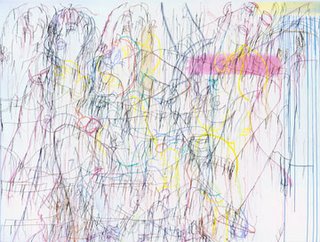
Other canvases in the narrow back gallery were square and black with nearly illegible text stitched in and covered in tar. The text appeared to have a vaguely revolutionary content, but I certainly didn't have the patience to decipher it.
The Point, as far as I understood it, was the usual stuff about women's processes versus women's image, as objectified by Society, and the Male Gaze, and all that. Probably. I suppose. Since I'm not a professional reviewer I'll skip the lingo.
My concern, though, is that in terms of actual physical affect these pieces are kind of ho-hum. They have roughly ten percent of the energy of a middle-stage Guston. They're primarily about a Sisyphean process, lending weight to a paper-thin, static sociopolitical commentary.
What kind of daily life of the mind must this artist have, then--stitching, stitching, stitching, making the occasional aesthetic decision but largely just doing busy work? And all for a show that is Flavor of the Month at Gagosian, hip and trendy for now, but utterly gone by March? Is her life as a big-league artist at all satisfying in its balance and creative exploration, or is she sacrificing the blood of her thousand-hour days to the dealer's need to exhibit Big and Strange?
Just asking.
On to Mary Boone, where somebody had curated a somewhat random group show of famously shallow, staggeringly priced artists, Warhol and Koons among them. I'm not sure why this show was happening in January at all--it had the flavor of a late-summer throw-together done by a flunkey, when dealers, patrons and critics are all upstate, detoxing in Nature. Its most salient feature was a mirrored floor which made us slightly queasy. I checked the price list and all the works were in the six-to-seven-figure range, all with red dots, except the floor. I suppose even the super-rich collectors draw the line at actual vertigo in the home.
But it was the Thomas Hirschhorn show at Barbara Gladstone which delivered the coup de grace, rendering me, at least, literally too nauseated to continue. It was called, with refreshing honesty, "Superficial Engagement." At first glance it looked like an installation by one of those outsider artists who fills vacant lots with a labyrinth of psychotic crap--mannequins drilled full of screws, cut-out signs, thrift-store art and magazine collage. Upon closer inspection the magazine photos turned out to be unsparingly graphic images of roughly dismembered human corpses, more and more and more and more of them. Side by side with these were lots of pretty Spirograph drawings, String Art, and plasma screens with planetary images twirling peacefully round. I mean to say, huh?
Upon reading the press release, I discovered that the artist's concern is to engage the viewer at a level too superficial for political discourse to enter, on a number of arenas at once. He succeeds. With a sledgehammer. The work has no grace and no finesse, and is less deep and real than a visit to Coney Island. On an energetic level I can actually appreciate what he is trying to do--he is acknowleging the strata of body, darkness, violence, density, and fear; simultaneously the intellect with its medium of language, simultaneously the spirit with unity and peace. Unfortunately the first is all too easy, and the last is all too perfunctory. He must be a tired, tired man.
There may be hundreds of galleries in Chelsea, but the big ones at street level get 80-90% of the walk-by traffic. We got through Gagosian, Mary Boone, Barbara Gladstone, and a couple of pretenders whose names I cannot now recall, before collapsing. It was the Thomas Hirschhorn show that did us in--more on that in a moment.
What I notice about big-ass art dealers, usually, is that they foster art which is Big and Thin. It must be large enough to fill a room the size of a basketball court; it must be, in some way, obsessively strange and trivial; it must take a lot of work to make a fairly obvious point, in a staggeringly arcane way.
Case in point: the Ghada Amer show at Gagosian. The pieces are, after all, mildly neat. They are huge canvases with repetitive, overlapping images, evidently stolen from Hustler and Disney, stitched into the canvas by hand with thousands of dangling threads.
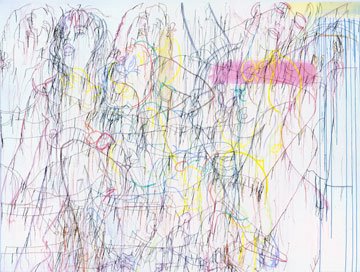
Other canvases in the narrow back gallery were square and black with nearly illegible text stitched in and covered in tar. The text appeared to have a vaguely revolutionary content, but I certainly didn't have the patience to decipher it.
The Point, as far as I understood it, was the usual stuff about women's processes versus women's image, as objectified by Society, and the Male Gaze, and all that. Probably. I suppose. Since I'm not a professional reviewer I'll skip the lingo.
My concern, though, is that in terms of actual physical affect these pieces are kind of ho-hum. They have roughly ten percent of the energy of a middle-stage Guston. They're primarily about a Sisyphean process, lending weight to a paper-thin, static sociopolitical commentary.
What kind of daily life of the mind must this artist have, then--stitching, stitching, stitching, making the occasional aesthetic decision but largely just doing busy work? And all for a show that is Flavor of the Month at Gagosian, hip and trendy for now, but utterly gone by March? Is her life as a big-league artist at all satisfying in its balance and creative exploration, or is she sacrificing the blood of her thousand-hour days to the dealer's need to exhibit Big and Strange?
Just asking.
On to Mary Boone, where somebody had curated a somewhat random group show of famously shallow, staggeringly priced artists, Warhol and Koons among them. I'm not sure why this show was happening in January at all--it had the flavor of a late-summer throw-together done by a flunkey, when dealers, patrons and critics are all upstate, detoxing in Nature. Its most salient feature was a mirrored floor which made us slightly queasy. I checked the price list and all the works were in the six-to-seven-figure range, all with red dots, except the floor. I suppose even the super-rich collectors draw the line at actual vertigo in the home.
But it was the Thomas Hirschhorn show at Barbara Gladstone which delivered the coup de grace, rendering me, at least, literally too nauseated to continue. It was called, with refreshing honesty, "Superficial Engagement." At first glance it looked like an installation by one of those outsider artists who fills vacant lots with a labyrinth of psychotic crap--mannequins drilled full of screws, cut-out signs, thrift-store art and magazine collage. Upon closer inspection the magazine photos turned out to be unsparingly graphic images of roughly dismembered human corpses, more and more and more and more of them. Side by side with these were lots of pretty Spirograph drawings, String Art, and plasma screens with planetary images twirling peacefully round. I mean to say, huh?
Upon reading the press release, I discovered that the artist's concern is to engage the viewer at a level too superficial for political discourse to enter, on a number of arenas at once. He succeeds. With a sledgehammer. The work has no grace and no finesse, and is less deep and real than a visit to Coney Island. On an energetic level I can actually appreciate what he is trying to do--he is acknowleging the strata of body, darkness, violence, density, and fear; simultaneously the intellect with its medium of language, simultaneously the spirit with unity and peace. Unfortunately the first is all too easy, and the last is all too perfunctory. He must be a tired, tired man.
Wednesday, January 18, 2006
How to Stretch a Canvas
This post shouldn't be necessary. Two things, however, prompted me to write it: 1) the time I was carrying a 4'x5' piece into a BWAC exhibition, and another 'artist' said, 'did you stretch that yourself? Wow, I never learned how to do that.' 2) during my open studio, I received a visit from an individual with an MFA (correspondence) who holds a position of some responsibility in a Brooklyn arts organization. Her comment was more or less the same as 1), with the addendum, 'you got it so tight and even. Badly stretched canvases look like shit.'
Well, duh. I don't know why I should be so shocked by this, but folks, this is basic. Not only that, but I think that these people's comments reflect badly upon their assumptions about the level of professionalism of artists in general, and me in particular. I am the woman who packed her table saw in a truck and drove it to Mexico, to build her own stretcher bars on the roof, because Mexican carpenters have not yet discovered carbide-tipped saw blades, and kept making passes at me. I MEAN IT. I'M SERIOUS. Stop patronizing me.
Sorry to get testy so early in the day. Here we go.
I finally gave up building my own stretcher bars, because apartments in Brooklyn just aren't big enough to hold a table saw, and the weather is too bad to put it on the roof. These are Creative Mark heavy-duty 36" x 48" stretcher bars, ordered from Jerry's. They have bevelled edges and precision-cut corners; you still, however, have to be very careful to put them together at right angles.
 Set them up like this, against a wall.

Although the notches for the corners are cut for you, they won't just slide into place. You have to whack them with a hammer.
 Make sure each corner is squared with a T-square--do not eyeball it. Gabriel will supervise.
Glue is actually not required for these types of corners, which is useful if you succumb to wishful thinking and discover, later on, that you've gotten the corners crooked.
 Pre-cut and recessed cross-braces are also available through Jerry's. They will notch the center braces for you if you ask nicely, and if they happen to have the right lengths in stock (!@%!^$!#). For this canvas I am only bracing the long side, since for some reason they didn't carry 48" braces.
Measure and make sure that the brace is exactly in the center of both sides. It's no good if you brace it all caty-wompus.
 Glue and nail the brace into place--the nails are only to hold it until the glue dries. Gabriel will supervise the glue cap.

Now we measure and cut the canvas. This is heavy, rough-weave Polish linen; as you can see, I am only using cotton duck canvas for a drop cloth. That is because the linen is a phenomenally beautiful, high-vibration, organic thing, all by itself--you put a stroke of paint on it and it already looks like a Degas. Cotton duck canvas is just blah. Linen is also phenomenally expensive, which is why I didn't start painting on it until I'd been practicing for 17 years. It's also why you have to take out a third mortgage to afford one of my big paintings (sorry, Badger.)
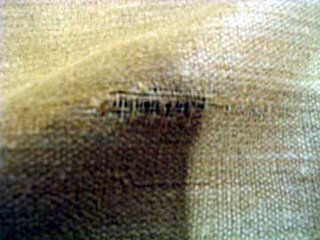 Oops. High texture is a good thing; holes in the canvas are not.

Avoiding the hole. The extra foot of damaged canvas goes into the bag of interesting things for fooling around with later.

 As far as I know, other artists may skip this step--most wrinkles will be removed in the stretching and gessoing process. However, if the wrinkle does survive the gessoing, it's permanent. I'd rather not take that risk.
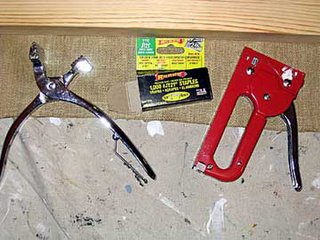 Necessary stretching tools: canvas pliers, staples, staple gun. Always take the old staple box with you to the hardware store when buying new ones, preferably with a few staples still in it to compare. All 1/4", 6mm staples are not created equal, damn and blast. I've already made two trips to Lowe's this week, and now I have to go to Home Depot.
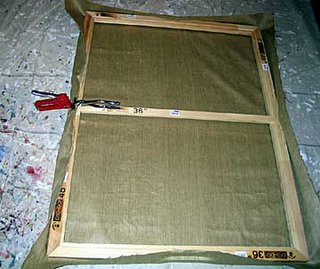 Now we get to the crux of canvas stretching technique. Start from the center. Put two or three staples in the middle of one side, then go to the side directly across from it, pull as hard as you can, and put two or three staples in. Then do the same on the other two sides, so that you have a diamond of tightness in the middle. Keep moving around, working out from the center, pulling with the pliers as you staple.
 To use the pliers, fold the edge you are working on to get a good grip. Use the bump on the top of the pliers against the stretcher for leverage. Pull the pliers over, back and down to get the canvas as tight as possible, then staple it down. Using pliers and a good staple gun will still not protect your hands completely; you know you're doing it right when there is no skin left on your knuckles.
 Work around as evenly as possible until you get to the corners. The corners are the hardest part; keep using the pliers until you can't possibly get a grip on them any more. You don't want a loose pooch at the corner. Before you staple the corner down, fold the canvas so that the double thickness is underneath, and the fold occurs right at the corner, like so:
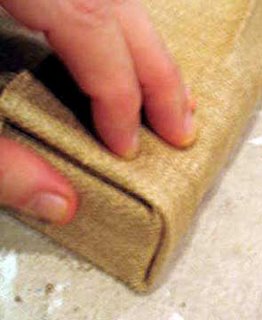 Then staple that baby down.
 With any luck, once you get all the staples in, it should look pretty good. It probably won't be perfect, however; with all your best efforts, there will still be a few puckers. Don't panic. Before ripping out the staples and trying again, spray a little water on the puckers and see if they vanish. A coat of gesso will usually tighten away wrinkles, too, but it's best to try the water first.

 Spraying water on the back is also a good way to tighten a canvas that has gotten all loose and shimmery because the weather has changed, as weather tends to do. Remember that wood, fabric, oil and wax are all organic substances; their condition fluctuates with the seasons. You can't be rigid in your expectations of them. Even with your best efforts, a canvas will still sometimes come out with a torque in the bar, so that one corner pops off the wall; this is what frames are for.
You can also use those little wedges of wood that you slide in the notches at the corners to tighten a loose canvas; these are called 'corner keys.' I was using them wrong at first, gluing them in when I built the stretcher, so that when I discovered my corners weren't square, there was nothing that could be done. Let this be a lesson to you.
You say, my God, Serena, you are known for boring and long-winded posts, but this one takes the cake. Why, Serena, why?
Well, this is an illustration of just how much work it takes to create the illusion that no work has been done at all. You only notice the canvas when something has gone wrong; when there is a pucker, a corner popping up, a ragged edge peeping out the back. If I don't get this stuff right, all future labors will be in vain.
And we have not even gotten around to taping and gessoing yet.
Well, duh. I don't know why I should be so shocked by this, but folks, this is basic. Not only that, but I think that these people's comments reflect badly upon their assumptions about the level of professionalism of artists in general, and me in particular. I am the woman who packed her table saw in a truck and drove it to Mexico, to build her own stretcher bars on the roof, because Mexican carpenters have not yet discovered carbide-tipped saw blades, and kept making passes at me. I MEAN IT. I'M SERIOUS. Stop patronizing me.
Sorry to get testy so early in the day. Here we go.
I finally gave up building my own stretcher bars, because apartments in Brooklyn just aren't big enough to hold a table saw, and the weather is too bad to put it on the roof. These are Creative Mark heavy-duty 36" x 48" stretcher bars, ordered from Jerry's. They have bevelled edges and precision-cut corners; you still, however, have to be very careful to put them together at right angles.
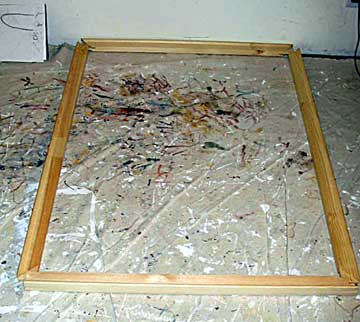 Set them up like this, against a wall.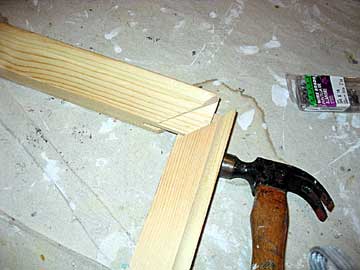
Although the notches for the corners are cut for you, they won't just slide into place. You have to whack them with a hammer.
 Make sure each corner is squared with a T-square--do not eyeball it. Gabriel will supervise.
Glue is actually not required for these types of corners, which is useful if you succumb to wishful thinking and discover, later on, that you've gotten the corners crooked.
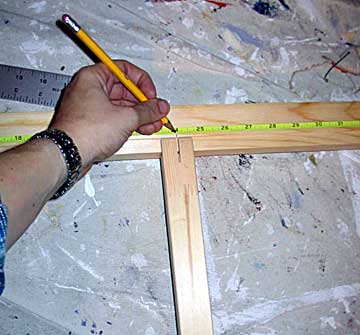 Pre-cut and recessed cross-braces are also available through Jerry's. They will notch the center braces for you if you ask nicely, and if they happen to have the right lengths in stock (!@%!^$!#). For this canvas I am only bracing the long side, since for some reason they didn't carry 48" braces.
Measure and make sure that the brace is exactly in the center of both sides. It's no good if you brace it all caty-wompus.
 Glue and nail the brace into place--the nails are only to hold it until the glue dries. Gabriel will supervise the glue cap.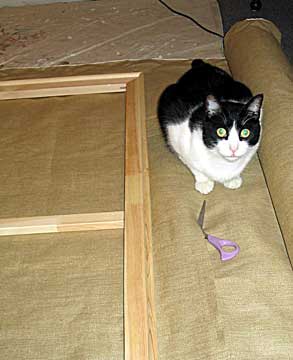
Now we measure and cut the canvas. This is heavy, rough-weave Polish linen; as you can see, I am only using cotton duck canvas for a drop cloth. That is because the linen is a phenomenally beautiful, high-vibration, organic thing, all by itself--you put a stroke of paint on it and it already looks like a Degas. Cotton duck canvas is just blah. Linen is also phenomenally expensive, which is why I didn't start painting on it until I'd been practicing for 17 years. It's also why you have to take out a third mortgage to afford one of my big paintings (sorry, Badger.)
 Oops. High texture is a good thing; holes in the canvas are not.
Avoiding the hole. The extra foot of damaged canvas goes into the bag of interesting things for fooling around with later.

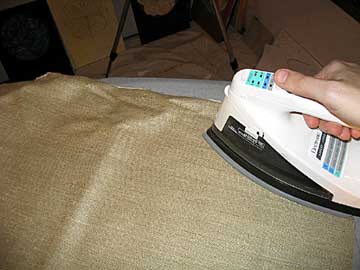 As far as I know, other artists may skip this step--most wrinkles will be removed in the stretching and gessoing process. However, if the wrinkle does survive the gessoing, it's permanent. I'd rather not take that risk.
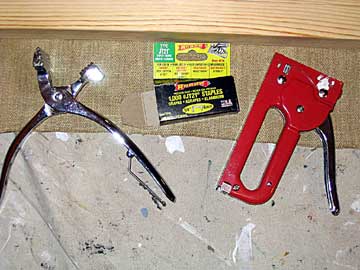 Necessary stretching tools: canvas pliers, staples, staple gun. Always take the old staple box with you to the hardware store when buying new ones, preferably with a few staples still in it to compare. All 1/4", 6mm staples are not created equal, damn and blast. I've already made two trips to Lowe's this week, and now I have to go to Home Depot.
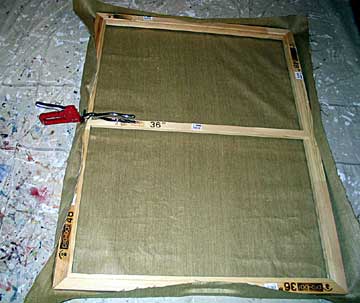 Now we get to the crux of canvas stretching technique. Start from the center. Put two or three staples in the middle of one side, then go to the side directly across from it, pull as hard as you can, and put two or three staples in. Then do the same on the other two sides, so that you have a diamond of tightness in the middle. Keep moving around, working out from the center, pulling with the pliers as you staple.
 To use the pliers, fold the edge you are working on to get a good grip. Use the bump on the top of the pliers against the stretcher for leverage. Pull the pliers over, back and down to get the canvas as tight as possible, then staple it down. Using pliers and a good staple gun will still not protect your hands completely; you know you're doing it right when there is no skin left on your knuckles.
 Work around as evenly as possible until you get to the corners. The corners are the hardest part; keep using the pliers until you can't possibly get a grip on them any more. You don't want a loose pooch at the corner. Before you staple the corner down, fold the canvas so that the double thickness is underneath, and the fold occurs right at the corner, like so:
 Then staple that baby down.
 With any luck, once you get all the staples in, it should look pretty good. It probably won't be perfect, however; with all your best efforts, there will still be a few puckers. Don't panic. Before ripping out the staples and trying again, spray a little water on the puckers and see if they vanish. A coat of gesso will usually tighten away wrinkles, too, but it's best to try the water first.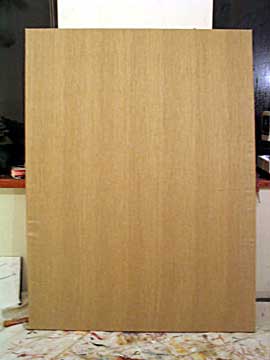
 Spraying water on the back is also a good way to tighten a canvas that has gotten all loose and shimmery because the weather has changed, as weather tends to do. Remember that wood, fabric, oil and wax are all organic substances; their condition fluctuates with the seasons. You can't be rigid in your expectations of them. Even with your best efforts, a canvas will still sometimes come out with a torque in the bar, so that one corner pops off the wall; this is what frames are for.
You can also use those little wedges of wood that you slide in the notches at the corners to tighten a loose canvas; these are called 'corner keys.' I was using them wrong at first, gluing them in when I built the stretcher, so that when I discovered my corners weren't square, there was nothing that could be done. Let this be a lesson to you.
You say, my God, Serena, you are known for boring and long-winded posts, but this one takes the cake. Why, Serena, why?
Well, this is an illustration of just how much work it takes to create the illusion that no work has been done at all. You only notice the canvas when something has gone wrong; when there is a pucker, a corner popping up, a ragged edge peeping out the back. If I don't get this stuff right, all future labors will be in vain.
And we have not even gotten around to taping and gessoing yet.
Thursday, January 12, 2006
Seed harmonics
Today while massaging a client and listening to the Windham Hill version of "Greensleeves" (one of my favorites, it's so ripply) it occurred to me that it would be possible to do a whole series of little drawings, paintings, sculptures, silly objects, scattered all around the walls, floors and ceilings, relating to one another in a harmonic way--like ripples.
 This sort of thing has occurred to me before, of course, but I couldn't think of a properly art-speaky way of justifying it, so I let it languish. Well, fuck that.
 This sort of thing has occurred to me before, of course, but I couldn't think of a properly art-speaky way of justifying it, so I let it languish. Well, fuck that.
Monday, January 09, 2006
Long little sketch
A painting professor (Richard Thompson, NOT the musician) once said to me, "pay attention to the littlest, most dumb idea you have. That is what makes your art unique." In this spirit, yesterday I made a dumb little wave:
 Believe it or not, this was the largest I could get the image to display. You see, though, how dumb it is. Just a lot of little curlicues. I can't seem to help drawing curlicues; have drawn them since I was old enough to hold a pencil.
But it was kind of fun to make each little drawing talk to the one next to it, moving and flowing but remaining fundamentally the same thing.
Any ideas for how to mount this sort of piece, cheaply? Other than with binder clips?
 Believe it or not, this was the largest I could get the image to display. You see, though, how dumb it is. Just a lot of little curlicues. I can't seem to help drawing curlicues; have drawn them since I was old enough to hold a pencil.
 But it was kind of fun to make each little drawing talk to the one next to it, moving and flowing but remaining fundamentally the same thing.
Any ideas for how to mount this sort of piece, cheaply? Other than with binder clips?
Subscribe to:
Posts (Atom)


