Okay, so what happened was that Earthlink transferred my phone service to themselves as of July 1, and mailed the equipment needed to access said phone service to an address in Oakland, CA that I haven't inhabited since the year 2000. After they'd used up over an hour of my remaining cell phone minutes, putting me on hold, they earnestly declared that they'd have my calls forwarded to the cell phone in oh, twenty-four hours. They're overnighting me the equipment, probably by tomorrow, which means that it should be here by Saturday.
Which means that my client base has had a full week to call me, get a message saying that I'm 'unavailable,' decide that I'm out of town or dead, and find another massage therapist. Hoo-whee.
So if anybody is needing to call me, please dial (718)384-6773. I promise that I won't whine at you for very long, since I haven't got many cell phone minutes left.
Thursday, July 06, 2006

Wednesday, July 05, 2006
Don't Fade Away (Featuring Sophie Jodoin)
I've figured out why I've been in such a foul mood for the last few days.
Four years ago, in June, I moved to New York. When I arrived at my new apartment, at 9 PM on a Friday night, it had been trashed. The power, phone and TV cables were cut, the intercom was smashed, it was about 104 degrees indoors and smelled like cat pee and moth balls. The movers, meanwhile, failed to deliver my personal effects until two months after I arrived. My only friend in New York suddenly turned into a paranoid, passive-aggressive freak and stopped returning my phone calls. I spent the Fourth of July wandering the streets of Manhattan at random, watching the first post 9-11 fireworks among a crowd of strangers. I don't think I spoke to another human being the entire day.
 Three years ago, on the Fourth, I was opening my new gallery. I was stressed, anxious and proud; there was a big party in the building, largely consisting of strangers with whom I had little in common.
Two years ago, on the Fourth, I was getting dumped. I was the biggest wreck I've ever been in my entire life.
One year ago, on the Fourth, I was in a period of prolonged, self-imposed isolation, re-examining every single habitual way I relate to other people. I spent the evening on my roof, watching the fireworks, and talking with my next-door neighbor.

Basically, the Fourth of July in New York City does not hold too many positive associations for me. It's not only hot but muggy; it feels simultaneously oppressive and isolating. Plus, once you've gotten into the habit of self-isolation, it's a difficult one to break, like most habits. I start assuming that something bad will happen if I, like, call someone.
Perhaps the fact that both my phone lines went inexplicably dead over the weekend has to do with physical reality manifesting out of my state of mind. Or maybe that's narcissistic.
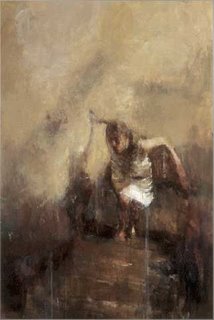
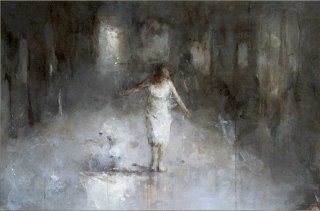
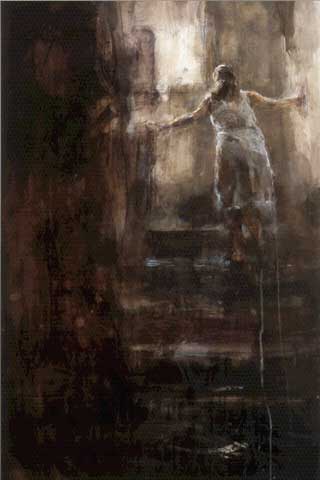
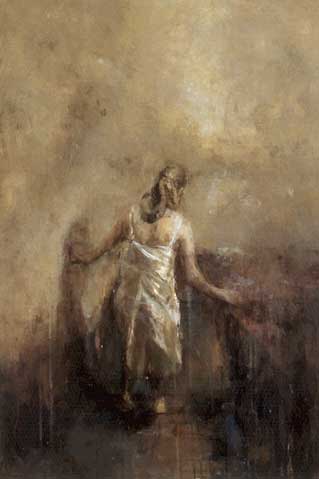
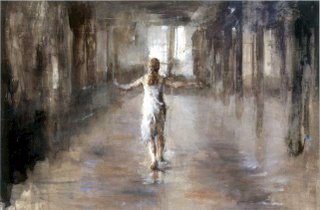
Anyway, this has nothing at all to do with the work of Sophie Jodoin, which Painterdog has so generously encouraged us to look at. The images posted here are all from her series, "Don't Fade Away," 2000, which are not necessarily representative, but which touched me deeply, for perhaps obvious reasons.
Sophie's work is proof positive that you can still say something modern and individual with classical painting technique. Sophie does whole series of portraits where the figure is a tiny, isolated speck in the middle of a large canvas; she does other series which look like ancient masterpieces which have been through a shipwreck. The luminosity, the marrying of nail-on-the-head realism with textural abstraction and gestural freedom are unparalleled in anything else I've seen, and that includes Odd Nerdrum. (What's with those weird rants about Kitsch on the main page? Odd Nerdrum is not Kitsch in any sense of the word. He's way too strange.)
Her work is a perfect example of how technique at its best is merely a tool for fluidity of self-expression. These paintings are obviously modern; the moods, the subjects, the compositions only make sense in the context, both of a long history of painting, and of our uncertain and socially isolated era. They're not about saying "look at me; I can paint like Rembrandt!" as much as they're about taking what's transcendent about Rembrandt's technique and bringing it to apply on deeply personal subjects.
This is far, far different from what negative, snotty brats like John Currin are doing. After reading Peter Schjeldahl's review of the Currin retrospective at the Whitney, I expected to like it better than I did. But the aggregate effect of perusing a decade and a half of Currin's work in one fell swoop was, simply, icky. You got the feeling that this artist is a soulless, cynical creep who just applies his technique in the service of thumbing his nose at everybody--artists and regular people, past, present and future. He's all references and no center.
Sophie's work may be much subtler than Currin's, as well as much more sincere; sincerity may indeed be out of fashion. But the depth that comes of mining a simple subject with patience and commitment holds up, for me, much better than Currin's snarky pot-shots. It bespeaks both humility and maturity.

Four years ago, in June, I moved to New York. When I arrived at my new apartment, at 9 PM on a Friday night, it had been trashed. The power, phone and TV cables were cut, the intercom was smashed, it was about 104 degrees indoors and smelled like cat pee and moth balls. The movers, meanwhile, failed to deliver my personal effects until two months after I arrived. My only friend in New York suddenly turned into a paranoid, passive-aggressive freak and stopped returning my phone calls. I spent the Fourth of July wandering the streets of Manhattan at random, watching the first post 9-11 fireworks among a crowd of strangers. I don't think I spoke to another human being the entire day.
 Three years ago, on the Fourth, I was opening my new gallery. I was stressed, anxious and proud; there was a big party in the building, largely consisting of strangers with whom I had little in common.

Two years ago, on the Fourth, I was getting dumped. I was the biggest wreck I've ever been in my entire life.

One year ago, on the Fourth, I was in a period of prolonged, self-imposed isolation, re-examining every single habitual way I relate to other people. I spent the evening on my roof, watching the fireworks, and talking with my next-door neighbor.

Basically, the Fourth of July in New York City does not hold too many positive associations for me. It's not only hot but muggy; it feels simultaneously oppressive and isolating. Plus, once you've gotten into the habit of self-isolation, it's a difficult one to break, like most habits. I start assuming that something bad will happen if I, like, call someone.

Perhaps the fact that both my phone lines went inexplicably dead over the weekend has to do with physical reality manifesting out of my state of mind. Or maybe that's narcissistic.
Anyway, this has nothing at all to do with the work of Sophie Jodoin, which Painterdog has so generously encouraged us to look at. The images posted here are all from her series, "Don't Fade Away," 2000, which are not necessarily representative, but which touched me deeply, for perhaps obvious reasons.
Sophie's work is proof positive that you can still say something modern and individual with classical painting technique. Sophie does whole series of portraits where the figure is a tiny, isolated speck in the middle of a large canvas; she does other series which look like ancient masterpieces which have been through a shipwreck. The luminosity, the marrying of nail-on-the-head realism with textural abstraction and gestural freedom are unparalleled in anything else I've seen, and that includes Odd Nerdrum. (What's with those weird rants about Kitsch on the main page? Odd Nerdrum is not Kitsch in any sense of the word. He's way too strange.)
Her work is a perfect example of how technique at its best is merely a tool for fluidity of self-expression. These paintings are obviously modern; the moods, the subjects, the compositions only make sense in the context, both of a long history of painting, and of our uncertain and socially isolated era. They're not about saying "look at me; I can paint like Rembrandt!" as much as they're about taking what's transcendent about Rembrandt's technique and bringing it to apply on deeply personal subjects.
This is far, far different from what negative, snotty brats like John Currin are doing. After reading Peter Schjeldahl's review of the Currin retrospective at the Whitney, I expected to like it better than I did. But the aggregate effect of perusing a decade and a half of Currin's work in one fell swoop was, simply, icky. You got the feeling that this artist is a soulless, cynical creep who just applies his technique in the service of thumbing his nose at everybody--artists and regular people, past, present and future. He's all references and no center.
Sophie's work may be much subtler than Currin's, as well as much more sincere; sincerity may indeed be out of fashion. But the depth that comes of mining a simple subject with patience and commitment holds up, for me, much better than Currin's snarky pot-shots. It bespeaks both humility and maturity.
Monday, July 03, 2006
Grrrrr.
Excuse me, folks. I am in a Mood. Just received a call from an alleged potential client. "Do you do Tantra?"
"NO, ABSOLUTELY NOT," I said.
"What do you do?"
I went into my schpiel about integrated Swedish, Shiatsu, Deep Tissue, Reflexology and energy work. Not wanting to waste my breath, really, because a client who is clueless enough to ask about Tantra before identifying himself is not a client I want.
"Do you do Reiki?" he persisted.
"Yes, that's energy work," I replied.
"Do you do Reiki and Tantra?"
"NO. Tantra is erotic. I am a THERAPEUTIC massage therapist. I do not do sex work. Do you UNDERSTAND that?"
"Well, sometimes people do Reiki and Tantra together."
You are an idiot. Please go away.
"Well, I've never heard of that, and anyway I don't do Tantra. I have to be defensive with new clients, because some people do not understand the difference between massage therapy and sex work."
"I'll call you tomorrow around eight o'clock."
Yeah, right, dude, I will be available for a pervert who calls me last-minute on a holiday.
"Okay, call me when you're ready to MAKE AN APPOINTMENT. Bye."
Grrrrr.
This weekend, both my cell phone and my land line decided to simultaneously, inexplicably stop working. Which meant that I couldn't call either phone company and say, "What the hell?" but had to email them, which never works.
This afternoon the cell phone just as inexplicably started working again. I called the land line company and they said they'd do a line test and call me back. I'm still waiting.
Of course, I will be switching phone companies as soon as the correct cable box comes, anyway.
I DO NOT WANT TO BE HERE. I do not want to be in town for another Fourth of July. I want to be at a lake, with people, with a barbeque. Town is hot and oppressive and isolated and I DO NOT WANT TO BE HERE.
Sorry.
I DID have a new client call me the day after his session last week, just to tell me that his foot stopped hurting. He said it had been hurting for months, and the session healed it. This was nice. Now if only he tells 50 people so that I can pay my bills.
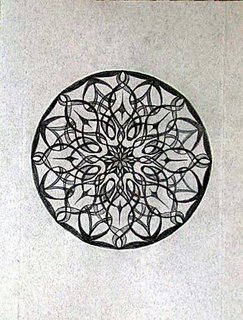
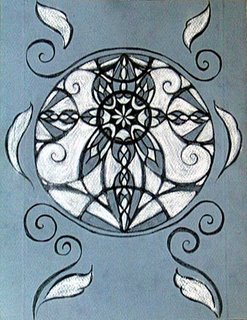
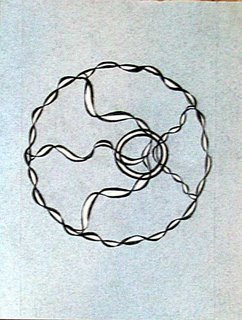
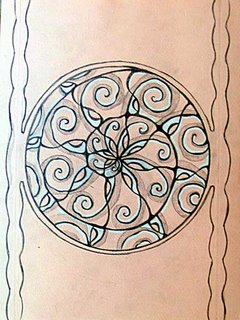
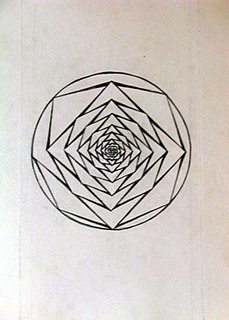
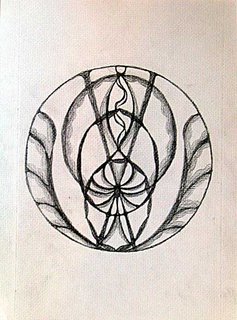
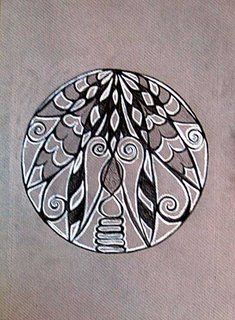
I have decided that I don't like working in a series where the pieces are intended to be grouped together. It works much better for me to do a series of individual pieces and then group them if I so choose. This column was loosely based on the chakra system, and frankly I don't like it much. I was so concerned with how each piece would 'relate' to the one next to it while I was working that I didn't push them far enough; thus I don't like either how they stand alone or how they stand in a group.
I did discover a number of ideas that I'd like to work with, however. Having the 'center point' pushed all the way to the edge is fun. Organic spirals are fun. Straight lines are fun. Twisted lines are fun. Having the pieces in a group is fun, as long as I don't plan it that way beforehand.
And I don't like doing borders, either. Feels like I'm drawing a picture frame.
Grrrr.
"NO, ABSOLUTELY NOT," I said.
"What do you do?"

I went into my schpiel about integrated Swedish, Shiatsu, Deep Tissue, Reflexology and energy work. Not wanting to waste my breath, really, because a client who is clueless enough to ask about Tantra before identifying himself is not a client I want.

"Do you do Reiki?" he persisted.
"Yes, that's energy work," I replied.
"Do you do Reiki and Tantra?"

"NO. Tantra is erotic. I am a THERAPEUTIC massage therapist. I do not do sex work. Do you UNDERSTAND that?"
"Well, sometimes people do Reiki and Tantra together."
You are an idiot. Please go away.

"Well, I've never heard of that, and anyway I don't do Tantra. I have to be defensive with new clients, because some people do not understand the difference between massage therapy and sex work."

"I'll call you tomorrow around eight o'clock."
Yeah, right, dude, I will be available for a pervert who calls me last-minute on a holiday.
"Okay, call me when you're ready to MAKE AN APPOINTMENT. Bye."
Grrrrr.

This weekend, both my cell phone and my land line decided to simultaneously, inexplicably stop working. Which meant that I couldn't call either phone company and say, "What the hell?" but had to email them, which never works.
This afternoon the cell phone just as inexplicably started working again. I called the land line company and they said they'd do a line test and call me back. I'm still waiting.
Of course, I will be switching phone companies as soon as the correct cable box comes, anyway.

I DO NOT WANT TO BE HERE. I do not want to be in town for another Fourth of July. I want to be at a lake, with people, with a barbeque. Town is hot and oppressive and isolated and I DO NOT WANT TO BE HERE.
Sorry.
I DID have a new client call me the day after his session last week, just to tell me that his foot stopped hurting. He said it had been hurting for months, and the session healed it. This was nice. Now if only he tells 50 people so that I can pay my bills.
I have decided that I don't like working in a series where the pieces are intended to be grouped together. It works much better for me to do a series of individual pieces and then group them if I so choose. This column was loosely based on the chakra system, and frankly I don't like it much. I was so concerned with how each piece would 'relate' to the one next to it while I was working that I didn't push them far enough; thus I don't like either how they stand alone or how they stand in a group.
I did discover a number of ideas that I'd like to work with, however. Having the 'center point' pushed all the way to the edge is fun. Organic spirals are fun. Straight lines are fun. Twisted lines are fun. Having the pieces in a group is fun, as long as I don't plan it that way beforehand.
And I don't like doing borders, either. Feels like I'm drawing a picture frame.
Grrrr.
Thursday, June 29, 2006
Sunday Salon #1
There will DEFINITELY be a potluck at Serena's apartment on Sunday, July 9 at 7 PM. You are all invited. The safety screening procedure (insisted upon by Oriane) is as follows: go to Serena's website, find her email address or phone #, and contact her to RSVP and get directions.
If this goes well, we may institute a monthly tradition. Bring wine, bread, cheese or dessert, and gripes or observations on the state of Art in general, and the Art World in particular. Also feel free to bring a small piece of Art that you would like to discuss.
If this goes well, we may institute a monthly tradition. Bring wine, bread, cheese or dessert, and gripes or observations on the state of Art in general, and the Art World in particular. Also feel free to bring a small piece of Art that you would like to discuss.
Monday, June 26, 2006
WE ARE THE FREAKIN' 'ART WORLD'
From the comments section, below:
Welcome to the club.
This weekend, an artist friend and I did some halfhearted opening-hopping in Williamsburg. Critical velocity was not achieved. Quote from friend, "I don't want to stand around Pierogi waiting to get invited upstairs."
I, being the art world innocent that I am, didn't even know Pierogi had an upstairs. I will never be part of the 'in' crowd at Pierogi, since Pierogi only shows artwork that looks like lichen. I like lichen, but I don't paint like lichen. What is, is.
Then we wandered across to B & W. In B & W was a life-size white machette of a bathroom, made out of plastic, foam-core and Mylar. In the back room were some respirators painted white. In the courtyard was a white model house, set on white Styrofoam beams, surrounded by a forest of aluminum poles.
We decided that it must be one of those exhibitions where you have to read the text to understand what is going on, except that we didn't care enough to read the text. I glancingly noticed that one of my ex-boyfriend's friends was there; the ex-boyfriend of my ex-best-friend, in fact. We didn't acknowledge one another. He's a vacant, philandering twerp.
Then we went to that gallery that's in a garage; the one that made a name for itself by showing the sculpture of Britney Spears giving birth. The bad one. I forget the name. The garage gallery was showing about six paintings on plywood; they were round, they were silly, they looked like fake surrealistic clocks for your child's bedroom.
As we walked away, I told my friend, "I feel better about my own rate of productivity, now." I could have filled up that gallery three times in six weeks, at that rate.
Sunday the two of us went by P.S. 1. There were hundreds of people schmoozing on the patio, and dozens of people looking at the art. My favorite part of the art was the John Lurie exhibition; the paintings looked like bad five-year-old art at first, until you looked at the captions. My favorite was "Three dentists thinking about the same squirrel." It is not easy to precisely evoke the mentality of being five years old.
On the first floor and in the basement was a panoramic retrospective of 'body art.' I am sensitive; I skimmed a great deal of it. My friend declared, "I'd seen most of those actual pieces before." Both of us lived for extended periods of time in the Bay Area; "over it" does not quite cover how we feel about 'body art,' particularly the 'shocking' photos of people doing boring retro things like bondage, cutting and fisting. 'Body art' bores us silly. It precisely captures the mentality of being two years old, and focused with great fascination upon one's own ejecti. Living in the Bay Area, you get people doing 'body art' on your back patio, when you happen to live above Folsom Street.
Let's just say it doesn't speak to us. Or that it's speaking: it's going 'blah blah blah blah blah. Blah.'
For quite awhile now, I have had an inchoate sense that the 'art world' is not about art; it is about high school. Or rather, there are tiers of the 'art world' which precisely resemble high school, and that's fine for them. Not only do I not wish to engage with these tiers, I can't. We're not speaking the same language.
But then, I've never run into Anselm Kieffer at an 'art world scene' opening, so I don't feel too bad about it. Lee Bontecou fled the 'art world' several decades ago, and one piece of hers inspires me more than a whole museum full of tinned shit. My uber-hero, Isamu Noguchi, spent half of his later years in a quarry in rural Japan, and the other half in a courtyard in Queens.
People, friends, real artists all--the 'art world' has nothing to do with being an artist. Nothing. Let us tell ourselves this every morning until we truly understand it.
Now, who would like to come to Serena's apartment for dinner, weekend after next? Anyone with the taste and discrimination to read this blog is invited. We 'art world' outies must nourish and encourage one another.
I can paint but the art world around me tells me its not good enough or in vain with(for) the current aesthetic.
I have hard time right now dealing with people in the art world as my BS meter is getting more acute as I get older.
Welcome to the club.
This weekend, an artist friend and I did some halfhearted opening-hopping in Williamsburg. Critical velocity was not achieved. Quote from friend, "I don't want to stand around Pierogi waiting to get invited upstairs."
I, being the art world innocent that I am, didn't even know Pierogi had an upstairs. I will never be part of the 'in' crowd at Pierogi, since Pierogi only shows artwork that looks like lichen. I like lichen, but I don't paint like lichen. What is, is.
Then we wandered across to B & W. In B & W was a life-size white machette of a bathroom, made out of plastic, foam-core and Mylar. In the back room were some respirators painted white. In the courtyard was a white model house, set on white Styrofoam beams, surrounded by a forest of aluminum poles.
We decided that it must be one of those exhibitions where you have to read the text to understand what is going on, except that we didn't care enough to read the text. I glancingly noticed that one of my ex-boyfriend's friends was there; the ex-boyfriend of my ex-best-friend, in fact. We didn't acknowledge one another. He's a vacant, philandering twerp.
Then we went to that gallery that's in a garage; the one that made a name for itself by showing the sculpture of Britney Spears giving birth. The bad one. I forget the name. The garage gallery was showing about six paintings on plywood; they were round, they were silly, they looked like fake surrealistic clocks for your child's bedroom.
As we walked away, I told my friend, "I feel better about my own rate of productivity, now." I could have filled up that gallery three times in six weeks, at that rate.
Sunday the two of us went by P.S. 1. There were hundreds of people schmoozing on the patio, and dozens of people looking at the art. My favorite part of the art was the John Lurie exhibition; the paintings looked like bad five-year-old art at first, until you looked at the captions. My favorite was "Three dentists thinking about the same squirrel." It is not easy to precisely evoke the mentality of being five years old.
On the first floor and in the basement was a panoramic retrospective of 'body art.' I am sensitive; I skimmed a great deal of it. My friend declared, "I'd seen most of those actual pieces before." Both of us lived for extended periods of time in the Bay Area; "over it" does not quite cover how we feel about 'body art,' particularly the 'shocking' photos of people doing boring retro things like bondage, cutting and fisting. 'Body art' bores us silly. It precisely captures the mentality of being two years old, and focused with great fascination upon one's own ejecti. Living in the Bay Area, you get people doing 'body art' on your back patio, when you happen to live above Folsom Street.
Let's just say it doesn't speak to us. Or that it's speaking: it's going 'blah blah blah blah blah. Blah.'
For quite awhile now, I have had an inchoate sense that the 'art world' is not about art; it is about high school. Or rather, there are tiers of the 'art world' which precisely resemble high school, and that's fine for them. Not only do I not wish to engage with these tiers, I can't. We're not speaking the same language.
But then, I've never run into Anselm Kieffer at an 'art world scene' opening, so I don't feel too bad about it. Lee Bontecou fled the 'art world' several decades ago, and one piece of hers inspires me more than a whole museum full of tinned shit. My uber-hero, Isamu Noguchi, spent half of his later years in a quarry in rural Japan, and the other half in a courtyard in Queens.
People, friends, real artists all--the 'art world' has nothing to do with being an artist. Nothing. Let us tell ourselves this every morning until we truly understand it.
Now, who would like to come to Serena's apartment for dinner, weekend after next? Anyone with the taste and discrimination to read this blog is invited. We 'art world' outies must nourish and encourage one another.
Friday, June 23, 2006
Featuring Jeffrey Freedner
Painterdog responded to my last post with a comment warning artists to rethink their positions, if they find themselves approaching 40 and still aren't making any money with their art. Being, of course, a self-absorbed artist who takes a heightened interest in people who take an interest in me :-), I checked out his website. And now I am dedicating this post to explaining why I think his art is pretty great.
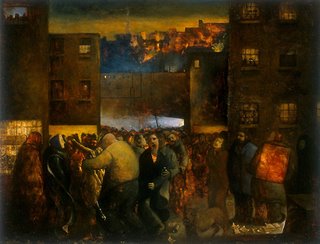 "Rembrandt's Carcass," oil on canvas, 18"x 24"
As you can see, this guy has done his classical-tradition homework. This is often looked down upon, or completely dismissed, in today's 'hip' art scene; I think the assumption is that it is not an innovative response to the modern world, but rather a reiteration of anachronistic forms to generate a recognizable 'art product' that may look good on a suburban wall, but doesn't make a statement beyond that.
And indeed, artists who do this often make a better living than those who don't, and aren't represented by a Chelsea gallery; retro art is much easier to sell to the masses. Witness the number of tourists in Soho who gobble up pseudo-Picasso prints as fast as they buy photographs of the Statue of Liberty.
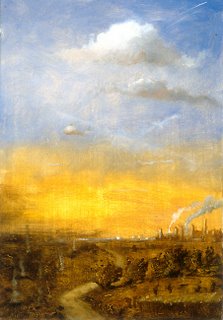 "Distant City," oil on board, 16"x 10"
Jeffrey, however, is not one of those artists. First of all, anachronistic copy-artists often ape a technique, rather than mastering it; they churn out stuff that sort of looks classical, but lacks the bang-on drawing, rich luminosity, or sophisticated, complex color composition of, say, a genuine Rembrandt or Bosch, which are two of the artists that Jeffrey's work brings to mind at first viewing.
But from what I can see of these paintings, it looks to me like Jeffrey has not only mastered drawing, luminosity, color composition and texture, he is using them to express a seamless, modern vision of his own. His figures may seem Bosch-esque, but they're neither literally depicted nor ripped-off from another artist. They feel directly observed, filtered through the lense of strong emotion and masterful technique, and conspire to create both a powerful visual image and a cohesive emotional affect.
And Jeffrey is doing this at a level of complexity that few painters can pull off. Look at "Rembrandt's Carcass." He has included at least eight different qualities of luminosity within the same painting, without making it feel completely chaotic; there is reflected incandescent light on the tile in the lower left, bright fluorescent searchlight in the center, sunset on the horizon, fire in the background, blue smoke picking up the searchlight, different qualities of interior light in the windows, and areas where all of these lights reflect in different ways off the figures and objects.
Folks, that is nothing to be sneezed at. I know at least one Chelsea painter who claims to 'do light well,' whose paintings sell in the five-digit range, who is incapable of this.

"Victim 2", oil on wood, 18"x 12"
Moreover, Jeffrey is using his technique to evoke emotions which may be timeless, but certainly aren't irrelevant to modern society. They're not just mindless, flat depictions of angst, either. In this painting, 'Victim 2,' the intense blue background provides a sense of simultaneous institutional displacement and a possible hope for transcendence; used to highlight an image of anonymous brutality, it is nevertheless purely beautiful in its essence.
My only complaint, in fact, is that the images on Jeffrey's website are only dated through 2002. Have you stopped painting, Jeffrey, or have you simply not updated your site?
I admit that many of these paintings would be difficult to live with, given the dark emotions which they express and the power with which they express it. It seems to require the power-politicking of a Chelsea dealer to convince collectors to purchase paintings like this, but it can certainly be done. I have visited the inside of one Park Avenue collector's house, which was full from basement to attic with angst-ridden, aggressive work by young artists that to me, would be much more difficult to look at every day than one of Jeffrey's paintings.
So anyway, Jeffrey, I don't know what to do about the fact that you seem to be producing gorgeous work that's having trouble finding its market. I can only say that it seems to me that you haven't been wasting your time.
 "Rembrandt's Carcass," oil on canvas, 18"x 24"
As you can see, this guy has done his classical-tradition homework. This is often looked down upon, or completely dismissed, in today's 'hip' art scene; I think the assumption is that it is not an innovative response to the modern world, but rather a reiteration of anachronistic forms to generate a recognizable 'art product' that may look good on a suburban wall, but doesn't make a statement beyond that.
And indeed, artists who do this often make a better living than those who don't, and aren't represented by a Chelsea gallery; retro art is much easier to sell to the masses. Witness the number of tourists in Soho who gobble up pseudo-Picasso prints as fast as they buy photographs of the Statue of Liberty.
 "Distant City," oil on board, 16"x 10"
Jeffrey, however, is not one of those artists. First of all, anachronistic copy-artists often ape a technique, rather than mastering it; they churn out stuff that sort of looks classical, but lacks the bang-on drawing, rich luminosity, or sophisticated, complex color composition of, say, a genuine Rembrandt or Bosch, which are two of the artists that Jeffrey's work brings to mind at first viewing.
But from what I can see of these paintings, it looks to me like Jeffrey has not only mastered drawing, luminosity, color composition and texture, he is using them to express a seamless, modern vision of his own. His figures may seem Bosch-esque, but they're neither literally depicted nor ripped-off from another artist. They feel directly observed, filtered through the lense of strong emotion and masterful technique, and conspire to create both a powerful visual image and a cohesive emotional affect.
And Jeffrey is doing this at a level of complexity that few painters can pull off. Look at "Rembrandt's Carcass." He has included at least eight different qualities of luminosity within the same painting, without making it feel completely chaotic; there is reflected incandescent light on the tile in the lower left, bright fluorescent searchlight in the center, sunset on the horizon, fire in the background, blue smoke picking up the searchlight, different qualities of interior light in the windows, and areas where all of these lights reflect in different ways off the figures and objects.
Folks, that is nothing to be sneezed at. I know at least one Chelsea painter who claims to 'do light well,' whose paintings sell in the five-digit range, who is incapable of this.

"Victim 2", oil on wood, 18"x 12"
Moreover, Jeffrey is using his technique to evoke emotions which may be timeless, but certainly aren't irrelevant to modern society. They're not just mindless, flat depictions of angst, either. In this painting, 'Victim 2,' the intense blue background provides a sense of simultaneous institutional displacement and a possible hope for transcendence; used to highlight an image of anonymous brutality, it is nevertheless purely beautiful in its essence.
My only complaint, in fact, is that the images on Jeffrey's website are only dated through 2002. Have you stopped painting, Jeffrey, or have you simply not updated your site?
I admit that many of these paintings would be difficult to live with, given the dark emotions which they express and the power with which they express it. It seems to require the power-politicking of a Chelsea dealer to convince collectors to purchase paintings like this, but it can certainly be done. I have visited the inside of one Park Avenue collector's house, which was full from basement to attic with angst-ridden, aggressive work by young artists that to me, would be much more difficult to look at every day than one of Jeffrey's paintings.
So anyway, Jeffrey, I don't know what to do about the fact that you seem to be producing gorgeous work that's having trouble finding its market. I can only say that it seems to me that you haven't been wasting your time.
Thursday, June 22, 2006
Advice and Support
The latest news in the mandala series is that now I have started on a seven-part 'totem' piece, which I will only post when I've finished all seven.
So for today, I have decided to comment on an issue which came up for me when reading Ed Winkleman's post, on the art world's alleged current obsession with youth. I have to admit that this issue has totally escaped me, since back when I WAS a callow young artist, I got slapped in the face enough times that I decided to go away and mature, and stop looking for gallery representation until I was a grown-up. Now I sort of think I AM a grown-up, and have peeped my nose into the gallery system once again, only to discover that I waited too long. Drat.
Be that as it may, the tangential issue which arose in my mind was the difference between offering advice to a young, struggling artist (or an old struggling artist) and actually supporting that artist. Advice without support may sometimes be wise, but it is not always helpful, and can frequently be counterproductive. Support, on the other hand, is NOT about taking responsibility for another person's career; it simply means taking some practical action on another person's behalf, if that action is easy for you, and if you genuinely believe the other person deserves it.
Advice, then, is saying "You should show your work to such-and-such gallery." Support is going to the dealer who is a personal friend of yours and saying, "So-and-so is talented and underrepresented, and I believe her work would fit nicely with your style." Because every artist knows that if you march into a gallery without an introduction and say, "Will you look at my work?" ninety-nine out of a hundred dealers will say, "Sorry, we're not taking submissions now." (I even had one gallerist follow this up with "It's a waste of time for me to look at your work," even though I had done my homework and attended every exhibition that this gallery had mounted for over a year.)
Advice is saying "You should show your work on the Upper East Side--that's your market." Support is actually showing up when your friend gets a show on the Upper East Side, bringing your wealthy Upper East Side relatives and mentioning it to the fifteen or twenty dealers you know personally.
Advice is critiquing someone's website or blog; support is linking to it and writing about the work. (Thank you, Chris.) Advice is saying, "your work would do well in X-Y-Z industry;" support is saying, "I have some personal connections in X-Y-Z industry. Would it be helpful for me to run your work by them?"
Advice is saying "You're a good artist and should be selling these;" support is actually buying them.
I know that all of this seems more than obvious. But what perhaps people don't always realize is that well-meaning advice can come across as more of a burden than a help. Sometimes the most supportive thing a friend can do is just sit and silently commiserate while you vent.
Subscribe to:
Posts (Atom)


