There will DEFINITELY be a potluck at Serena's apartment on Sunday, July 9 at 7 PM. You are all invited. The safety screening procedure (insisted upon by Oriane) is as follows: go to Serena's website, find her email address or phone #, and contact her to RSVP and get directions.
If this goes well, we may institute a monthly tradition. Bring wine, bread, cheese or dessert, and gripes or observations on the state of Art in general, and the Art World in particular. Also feel free to bring a small piece of Art that you would like to discuss.
Thursday, June 29, 2006

Monday, June 26, 2006
WE ARE THE FREAKIN' 'ART WORLD'
From the comments section, below:
Welcome to the club.
This weekend, an artist friend and I did some halfhearted opening-hopping in Williamsburg. Critical velocity was not achieved. Quote from friend, "I don't want to stand around Pierogi waiting to get invited upstairs."
I, being the art world innocent that I am, didn't even know Pierogi had an upstairs. I will never be part of the 'in' crowd at Pierogi, since Pierogi only shows artwork that looks like lichen. I like lichen, but I don't paint like lichen. What is, is.
Then we wandered across to B & W. In B & W was a life-size white machette of a bathroom, made out of plastic, foam-core and Mylar. In the back room were some respirators painted white. In the courtyard was a white model house, set on white Styrofoam beams, surrounded by a forest of aluminum poles.
We decided that it must be one of those exhibitions where you have to read the text to understand what is going on, except that we didn't care enough to read the text. I glancingly noticed that one of my ex-boyfriend's friends was there; the ex-boyfriend of my ex-best-friend, in fact. We didn't acknowledge one another. He's a vacant, philandering twerp.
Then we went to that gallery that's in a garage; the one that made a name for itself by showing the sculpture of Britney Spears giving birth. The bad one. I forget the name. The garage gallery was showing about six paintings on plywood; they were round, they were silly, they looked like fake surrealistic clocks for your child's bedroom.
As we walked away, I told my friend, "I feel better about my own rate of productivity, now." I could have filled up that gallery three times in six weeks, at that rate.
Sunday the two of us went by P.S. 1. There were hundreds of people schmoozing on the patio, and dozens of people looking at the art. My favorite part of the art was the John Lurie exhibition; the paintings looked like bad five-year-old art at first, until you looked at the captions. My favorite was "Three dentists thinking about the same squirrel." It is not easy to precisely evoke the mentality of being five years old.
On the first floor and in the basement was a panoramic retrospective of 'body art.' I am sensitive; I skimmed a great deal of it. My friend declared, "I'd seen most of those actual pieces before." Both of us lived for extended periods of time in the Bay Area; "over it" does not quite cover how we feel about 'body art,' particularly the 'shocking' photos of people doing boring retro things like bondage, cutting and fisting. 'Body art' bores us silly. It precisely captures the mentality of being two years old, and focused with great fascination upon one's own ejecti. Living in the Bay Area, you get people doing 'body art' on your back patio, when you happen to live above Folsom Street.
Let's just say it doesn't speak to us. Or that it's speaking: it's going 'blah blah blah blah blah. Blah.'
For quite awhile now, I have had an inchoate sense that the 'art world' is not about art; it is about high school. Or rather, there are tiers of the 'art world' which precisely resemble high school, and that's fine for them. Not only do I not wish to engage with these tiers, I can't. We're not speaking the same language.
But then, I've never run into Anselm Kieffer at an 'art world scene' opening, so I don't feel too bad about it. Lee Bontecou fled the 'art world' several decades ago, and one piece of hers inspires me more than a whole museum full of tinned shit. My uber-hero, Isamu Noguchi, spent half of his later years in a quarry in rural Japan, and the other half in a courtyard in Queens.
People, friends, real artists all--the 'art world' has nothing to do with being an artist. Nothing. Let us tell ourselves this every morning until we truly understand it.
Now, who would like to come to Serena's apartment for dinner, weekend after next? Anyone with the taste and discrimination to read this blog is invited. We 'art world' outies must nourish and encourage one another.
I can paint but the art world around me tells me its not good enough or in vain with(for) the current aesthetic.
I have hard time right now dealing with people in the art world as my BS meter is getting more acute as I get older.
Welcome to the club.
This weekend, an artist friend and I did some halfhearted opening-hopping in Williamsburg. Critical velocity was not achieved. Quote from friend, "I don't want to stand around Pierogi waiting to get invited upstairs."
I, being the art world innocent that I am, didn't even know Pierogi had an upstairs. I will never be part of the 'in' crowd at Pierogi, since Pierogi only shows artwork that looks like lichen. I like lichen, but I don't paint like lichen. What is, is.
Then we wandered across to B & W. In B & W was a life-size white machette of a bathroom, made out of plastic, foam-core and Mylar. In the back room were some respirators painted white. In the courtyard was a white model house, set on white Styrofoam beams, surrounded by a forest of aluminum poles.
We decided that it must be one of those exhibitions where you have to read the text to understand what is going on, except that we didn't care enough to read the text. I glancingly noticed that one of my ex-boyfriend's friends was there; the ex-boyfriend of my ex-best-friend, in fact. We didn't acknowledge one another. He's a vacant, philandering twerp.
Then we went to that gallery that's in a garage; the one that made a name for itself by showing the sculpture of Britney Spears giving birth. The bad one. I forget the name. The garage gallery was showing about six paintings on plywood; they were round, they were silly, they looked like fake surrealistic clocks for your child's bedroom.
As we walked away, I told my friend, "I feel better about my own rate of productivity, now." I could have filled up that gallery three times in six weeks, at that rate.
Sunday the two of us went by P.S. 1. There were hundreds of people schmoozing on the patio, and dozens of people looking at the art. My favorite part of the art was the John Lurie exhibition; the paintings looked like bad five-year-old art at first, until you looked at the captions. My favorite was "Three dentists thinking about the same squirrel." It is not easy to precisely evoke the mentality of being five years old.
On the first floor and in the basement was a panoramic retrospective of 'body art.' I am sensitive; I skimmed a great deal of it. My friend declared, "I'd seen most of those actual pieces before." Both of us lived for extended periods of time in the Bay Area; "over it" does not quite cover how we feel about 'body art,' particularly the 'shocking' photos of people doing boring retro things like bondage, cutting and fisting. 'Body art' bores us silly. It precisely captures the mentality of being two years old, and focused with great fascination upon one's own ejecti. Living in the Bay Area, you get people doing 'body art' on your back patio, when you happen to live above Folsom Street.
Let's just say it doesn't speak to us. Or that it's speaking: it's going 'blah blah blah blah blah. Blah.'
For quite awhile now, I have had an inchoate sense that the 'art world' is not about art; it is about high school. Or rather, there are tiers of the 'art world' which precisely resemble high school, and that's fine for them. Not only do I not wish to engage with these tiers, I can't. We're not speaking the same language.
But then, I've never run into Anselm Kieffer at an 'art world scene' opening, so I don't feel too bad about it. Lee Bontecou fled the 'art world' several decades ago, and one piece of hers inspires me more than a whole museum full of tinned shit. My uber-hero, Isamu Noguchi, spent half of his later years in a quarry in rural Japan, and the other half in a courtyard in Queens.
People, friends, real artists all--the 'art world' has nothing to do with being an artist. Nothing. Let us tell ourselves this every morning until we truly understand it.
Now, who would like to come to Serena's apartment for dinner, weekend after next? Anyone with the taste and discrimination to read this blog is invited. We 'art world' outies must nourish and encourage one another.
Friday, June 23, 2006
Featuring Jeffrey Freedner
Painterdog responded to my last post with a comment warning artists to rethink their positions, if they find themselves approaching 40 and still aren't making any money with their art. Being, of course, a self-absorbed artist who takes a heightened interest in people who take an interest in me :-), I checked out his website. And now I am dedicating this post to explaining why I think his art is pretty great.
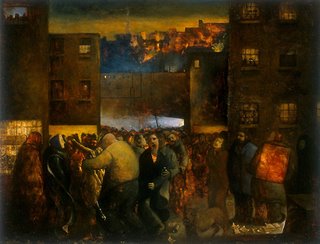 "Rembrandt's Carcass," oil on canvas, 18"x 24"
As you can see, this guy has done his classical-tradition homework. This is often looked down upon, or completely dismissed, in today's 'hip' art scene; I think the assumption is that it is not an innovative response to the modern world, but rather a reiteration of anachronistic forms to generate a recognizable 'art product' that may look good on a suburban wall, but doesn't make a statement beyond that.
And indeed, artists who do this often make a better living than those who don't, and aren't represented by a Chelsea gallery; retro art is much easier to sell to the masses. Witness the number of tourists in Soho who gobble up pseudo-Picasso prints as fast as they buy photographs of the Statue of Liberty.
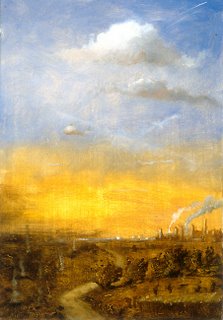 "Distant City," oil on board, 16"x 10"
Jeffrey, however, is not one of those artists. First of all, anachronistic copy-artists often ape a technique, rather than mastering it; they churn out stuff that sort of looks classical, but lacks the bang-on drawing, rich luminosity, or sophisticated, complex color composition of, say, a genuine Rembrandt or Bosch, which are two of the artists that Jeffrey's work brings to mind at first viewing.
But from what I can see of these paintings, it looks to me like Jeffrey has not only mastered drawing, luminosity, color composition and texture, he is using them to express a seamless, modern vision of his own. His figures may seem Bosch-esque, but they're neither literally depicted nor ripped-off from another artist. They feel directly observed, filtered through the lense of strong emotion and masterful technique, and conspire to create both a powerful visual image and a cohesive emotional affect.
And Jeffrey is doing this at a level of complexity that few painters can pull off. Look at "Rembrandt's Carcass." He has included at least eight different qualities of luminosity within the same painting, without making it feel completely chaotic; there is reflected incandescent light on the tile in the lower left, bright fluorescent searchlight in the center, sunset on the horizon, fire in the background, blue smoke picking up the searchlight, different qualities of interior light in the windows, and areas where all of these lights reflect in different ways off the figures and objects.
Folks, that is nothing to be sneezed at. I know at least one Chelsea painter who claims to 'do light well,' whose paintings sell in the five-digit range, who is incapable of this.

"Victim 2", oil on wood, 18"x 12"
Moreover, Jeffrey is using his technique to evoke emotions which may be timeless, but certainly aren't irrelevant to modern society. They're not just mindless, flat depictions of angst, either. In this painting, 'Victim 2,' the intense blue background provides a sense of simultaneous institutional displacement and a possible hope for transcendence; used to highlight an image of anonymous brutality, it is nevertheless purely beautiful in its essence.
My only complaint, in fact, is that the images on Jeffrey's website are only dated through 2002. Have you stopped painting, Jeffrey, or have you simply not updated your site?
I admit that many of these paintings would be difficult to live with, given the dark emotions which they express and the power with which they express it. It seems to require the power-politicking of a Chelsea dealer to convince collectors to purchase paintings like this, but it can certainly be done. I have visited the inside of one Park Avenue collector's house, which was full from basement to attic with angst-ridden, aggressive work by young artists that to me, would be much more difficult to look at every day than one of Jeffrey's paintings.
So anyway, Jeffrey, I don't know what to do about the fact that you seem to be producing gorgeous work that's having trouble finding its market. I can only say that it seems to me that you haven't been wasting your time.
 "Rembrandt's Carcass," oil on canvas, 18"x 24"
As you can see, this guy has done his classical-tradition homework. This is often looked down upon, or completely dismissed, in today's 'hip' art scene; I think the assumption is that it is not an innovative response to the modern world, but rather a reiteration of anachronistic forms to generate a recognizable 'art product' that may look good on a suburban wall, but doesn't make a statement beyond that.
And indeed, artists who do this often make a better living than those who don't, and aren't represented by a Chelsea gallery; retro art is much easier to sell to the masses. Witness the number of tourists in Soho who gobble up pseudo-Picasso prints as fast as they buy photographs of the Statue of Liberty.
 "Distant City," oil on board, 16"x 10"
Jeffrey, however, is not one of those artists. First of all, anachronistic copy-artists often ape a technique, rather than mastering it; they churn out stuff that sort of looks classical, but lacks the bang-on drawing, rich luminosity, or sophisticated, complex color composition of, say, a genuine Rembrandt or Bosch, which are two of the artists that Jeffrey's work brings to mind at first viewing.
But from what I can see of these paintings, it looks to me like Jeffrey has not only mastered drawing, luminosity, color composition and texture, he is using them to express a seamless, modern vision of his own. His figures may seem Bosch-esque, but they're neither literally depicted nor ripped-off from another artist. They feel directly observed, filtered through the lense of strong emotion and masterful technique, and conspire to create both a powerful visual image and a cohesive emotional affect.
And Jeffrey is doing this at a level of complexity that few painters can pull off. Look at "Rembrandt's Carcass." He has included at least eight different qualities of luminosity within the same painting, without making it feel completely chaotic; there is reflected incandescent light on the tile in the lower left, bright fluorescent searchlight in the center, sunset on the horizon, fire in the background, blue smoke picking up the searchlight, different qualities of interior light in the windows, and areas where all of these lights reflect in different ways off the figures and objects.
Folks, that is nothing to be sneezed at. I know at least one Chelsea painter who claims to 'do light well,' whose paintings sell in the five-digit range, who is incapable of this.

"Victim 2", oil on wood, 18"x 12"
Moreover, Jeffrey is using his technique to evoke emotions which may be timeless, but certainly aren't irrelevant to modern society. They're not just mindless, flat depictions of angst, either. In this painting, 'Victim 2,' the intense blue background provides a sense of simultaneous institutional displacement and a possible hope for transcendence; used to highlight an image of anonymous brutality, it is nevertheless purely beautiful in its essence.
My only complaint, in fact, is that the images on Jeffrey's website are only dated through 2002. Have you stopped painting, Jeffrey, or have you simply not updated your site?
I admit that many of these paintings would be difficult to live with, given the dark emotions which they express and the power with which they express it. It seems to require the power-politicking of a Chelsea dealer to convince collectors to purchase paintings like this, but it can certainly be done. I have visited the inside of one Park Avenue collector's house, which was full from basement to attic with angst-ridden, aggressive work by young artists that to me, would be much more difficult to look at every day than one of Jeffrey's paintings.
So anyway, Jeffrey, I don't know what to do about the fact that you seem to be producing gorgeous work that's having trouble finding its market. I can only say that it seems to me that you haven't been wasting your time.
Thursday, June 22, 2006
Advice and Support
The latest news in the mandala series is that now I have started on a seven-part 'totem' piece, which I will only post when I've finished all seven.
So for today, I have decided to comment on an issue which came up for me when reading Ed Winkleman's post, on the art world's alleged current obsession with youth. I have to admit that this issue has totally escaped me, since back when I WAS a callow young artist, I got slapped in the face enough times that I decided to go away and mature, and stop looking for gallery representation until I was a grown-up. Now I sort of think I AM a grown-up, and have peeped my nose into the gallery system once again, only to discover that I waited too long. Drat.
Be that as it may, the tangential issue which arose in my mind was the difference between offering advice to a young, struggling artist (or an old struggling artist) and actually supporting that artist. Advice without support may sometimes be wise, but it is not always helpful, and can frequently be counterproductive. Support, on the other hand, is NOT about taking responsibility for another person's career; it simply means taking some practical action on another person's behalf, if that action is easy for you, and if you genuinely believe the other person deserves it.
Advice, then, is saying "You should show your work to such-and-such gallery." Support is going to the dealer who is a personal friend of yours and saying, "So-and-so is talented and underrepresented, and I believe her work would fit nicely with your style." Because every artist knows that if you march into a gallery without an introduction and say, "Will you look at my work?" ninety-nine out of a hundred dealers will say, "Sorry, we're not taking submissions now." (I even had one gallerist follow this up with "It's a waste of time for me to look at your work," even though I had done my homework and attended every exhibition that this gallery had mounted for over a year.)
Advice is saying "You should show your work on the Upper East Side--that's your market." Support is actually showing up when your friend gets a show on the Upper East Side, bringing your wealthy Upper East Side relatives and mentioning it to the fifteen or twenty dealers you know personally.
Advice is critiquing someone's website or blog; support is linking to it and writing about the work. (Thank you, Chris.) Advice is saying, "your work would do well in X-Y-Z industry;" support is saying, "I have some personal connections in X-Y-Z industry. Would it be helpful for me to run your work by them?"
Advice is saying "You're a good artist and should be selling these;" support is actually buying them.
I know that all of this seems more than obvious. But what perhaps people don't always realize is that well-meaning advice can come across as more of a burden than a help. Sometimes the most supportive thing a friend can do is just sit and silently commiserate while you vent.
Monday, June 19, 2006
Feminine

This one reminds me of a vase on a patio behind an ironwork fence. I'll refrain from using the potentially pejorative term 'decorative' (oops, I just used it), but the energy, to me, is subtler and less aggressive than most of the previous ones. Which is appropriate, given the egg shapes that form the basis of the structure. Feminine energy.
Sunday, June 18, 2006
Failure and success
Okay, I admit that this piece is a complete failure.
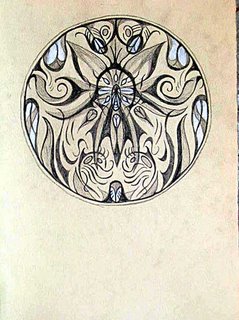 The problem is that I got too carried away with fun, funky, fiddly curves before laying down the basic overall structure, then tried to fill in the structure around the fiddly stuff. Which means it just looks random and non-cohesive. My underlying inspiration was spiky, thistle-like shapes, but I whacked into it without enough of a plan.
However, bearing this in mind, the next attempt was much more successful.
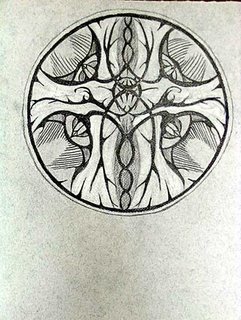
Thistles! Or maybe artichokes. Certainly something to explore further.
The next failed piece was conceived as a simple interference pattern, between two center points.
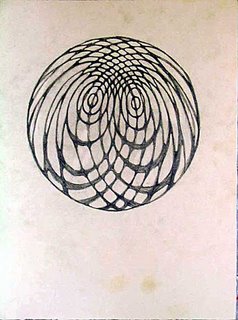
The problem with this one was that when I tried to do a more complex pattern, it became completely chaotic and unmanageable, but this is TOO simple. It could have been generated by a computer with more exactitude, but it would still be boring as batshit. It's no longer reading as a 'mandala', to my mind; it looks like a smear on the wall.
However, the one useful thing I learned while drawing it is that if you subtly emphasize the intersection points by accenting and smoothing the corners, it makes the whole image much more cohesive and dynamic, as though it were made of waves on water, or stained glass. I used this effect in the next two pieces:
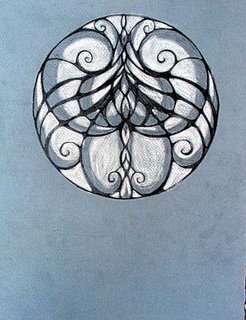 (And you thought the orchid was sexy...)
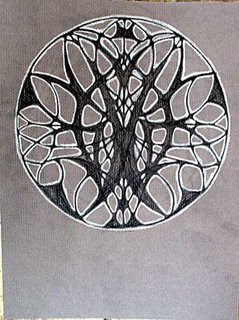
You may not even be able to see it in the digital image, but it is shocking how such a subtle adjustment causes the whole image to pull together and almost glow. What it seems to mean at this juncture is that I can start working with more-radical assymetries without losing grasp of the form as a whole. It also starts to make them feel slightly three-dimensional.
 The problem is that I got too carried away with fun, funky, fiddly curves before laying down the basic overall structure, then tried to fill in the structure around the fiddly stuff. Which means it just looks random and non-cohesive. My underlying inspiration was spiky, thistle-like shapes, but I whacked into it without enough of a plan.
However, bearing this in mind, the next attempt was much more successful.

Thistles! Or maybe artichokes. Certainly something to explore further.
The next failed piece was conceived as a simple interference pattern, between two center points.
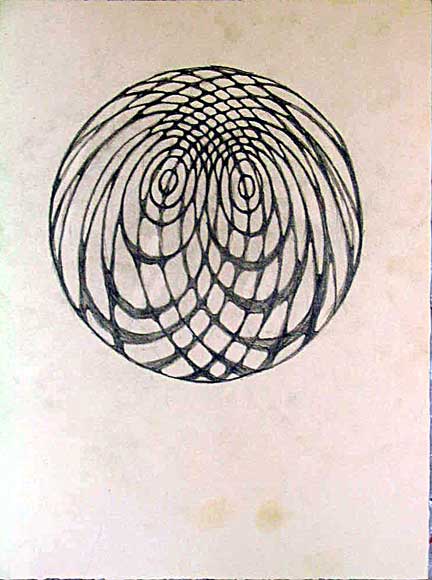
The problem with this one was that when I tried to do a more complex pattern, it became completely chaotic and unmanageable, but this is TOO simple. It could have been generated by a computer with more exactitude, but it would still be boring as batshit. It's no longer reading as a 'mandala', to my mind; it looks like a smear on the wall.
However, the one useful thing I learned while drawing it is that if you subtly emphasize the intersection points by accenting and smoothing the corners, it makes the whole image much more cohesive and dynamic, as though it were made of waves on water, or stained glass. I used this effect in the next two pieces:
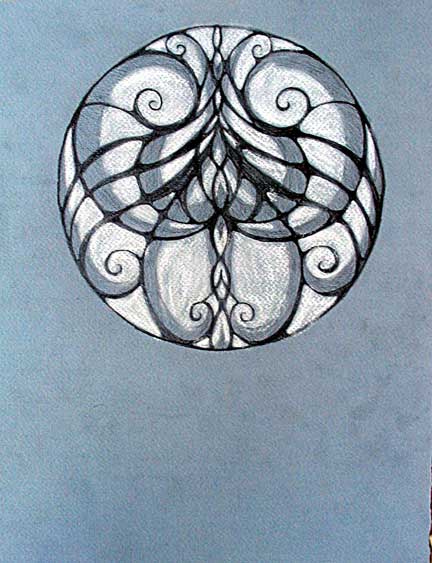 (And you thought the orchid was sexy...)
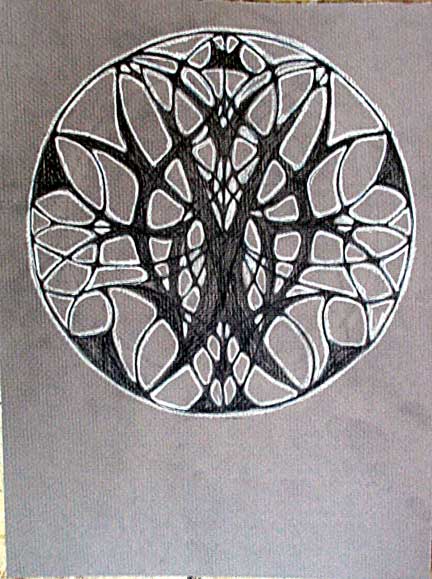
You may not even be able to see it in the digital image, but it is shocking how such a subtle adjustment causes the whole image to pull together and almost glow. What it seems to mean at this juncture is that I can start working with more-radical assymetries without losing grasp of the form as a whole. It also starts to make them feel slightly three-dimensional.
Wednesday, June 14, 2006
Bugs


While I was working on these, they seemed like they weren't hanging together, but when you put them up next to the symmetrical ones, they do hold up. It creates a tension of contrasts.
Subscribe to:
Posts (Atom)


